
Stay current with our airline news coverage.
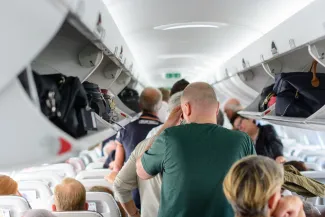
ORLANDO, Florida - There are few places on earth where you are more truly trapped than in an airplane cabin during a delay. You can't leave, you can't scroll away, and you definitely can't tune out the person standing in the aisle with a microphone complex and a message from God. Whitney Lynn, a 40-year-old Florida evangelist, discovered the hard limit of captive-audience evangelism on July 30 when she stood up during a ground delay on Alaska Airlines Flight 708 and began preaching to her fellow passengers, according to Yahoo. The flight, waiting at the gate at Orlando International Airport before departure to San Diego, had already been delayed. Lynn saw an opening. She stood, addressed the cabin, and delivered a message suggesting the delay was part of a larger plan, possibly sparing everyone from danger. The sermon lasted just under a minute. A crew call button chime can be heard in the background of the video she filmed and later posted to social media, one clip of which has now racked up millions of views. The crew's response was swift. Lynn was asked to deplane. Alaska Airlines subsequently banned her from flying with the carrier for the foreseeable future, citing safety concerns.
When the Sermon Becomes the Disruption
Lynn has since characterized the incident as "spiritual warfare," framing her removal as persecution for her Christian beliefs. She told her followers she plans to consult with an attorney and has vowed to continue preaching on future flights, wherever those flights might be booked now that Alaska, Hawaiian Airlines, and Horizon Air have placed a temporary hold on her travel privileges. But the online reaction to her videos has been less than reverent. "Please stop rewriting the story to make yourself the martyr. You weren't kicked off that flight because you were 'preaching the Gospel.' You were removed because you were being disruptive and imposing your preaching on an audience that never consented to it," one Instagram commenter wrote. Another asked, "Have you ever considered the pure unadulterated joy of minding your own business and celebrating your faith with people someplace else?" These are the comments of people who have, very likely, also been stuck in a delayed aircraft cabin with no escape route and diminishing patience.
The Consent Problem in Row 12
Airlines frame incidents like this through the lens of safety and crew discretion, and for good reason. Flight delays create tense, confined environments. Any behavior that escalates tension or makes crew uncomfortable gets treated as a disruption, whether it involves shouting about Jesus or shouting about literally anything else. The fact that Lynn's preaching lasted less than a minute is irrelevant if it took 30 seconds for a flight attendant to feel unsafe or for another passenger to hit the call button. Lynn's stated belief that passengers during a delay "have no choice but to hear the truth" is precisely the problem. Consent matters everywhere, but especially in spaces you cannot leave. A subway platform, you can walk away. A hostel common room, you can go upstairs. An airplane at the gate? You're pinned. You either endure the sermon or you make a scene trying to get off, which then becomes its own disruption. This is where the line between religious expression and coercion lives, and it's not a theoretical debate when you're in seat 12B with nowhere to go.
What Happens Next for Frequent Preachers
Lynn's temporary ban raises practical questions for anyone who treats commercial flights as their personal pulpit. Airlines have enormous latitude to refuse service to passengers they deem disruptive, and "disruptive" is a broad and intentionally flexible category. It includes the loud, the belligerent, the intoxicated, and increasingly, the performatively viral. Lynn filmed her sermon and her removal, turning a crew judgment call into content with millions of views. That changes the stakes for airlines, which now have to weigh not just the immediate cabin disruption but the reputational fallout of appearing to "silence" someone's faith. But the reality for travelers, especially those of us who live out of backpacks and budget airlines, is simpler: airlines will always prioritize crew comfort and operational efficiency over your personal mission, spiritual or otherwise. If a flight attendant says they don't feel safe, you're off the plane. Full stop. There is no appeals process at the gate, no jury of your peers in Terminal B. The FAA backs the crew. The airline backs the crew. And if you've been filming the whole thing for TikTok, congratulations, you've just made yourself extremely easy to ban. Lynn says she later prayed with a shuttle driver and a hotel front desk employee after her removal, which suggests she found her audience eventually, in spaces where people could politely excuse themselves if they chose. That's the model that works. The airplane cabin is not a church. It's not a stage. And for those of us who've spent enough years navigating long-haul flights, bus terminals, and hostel drama, the unspoken rule has always been the same: keep your revelations to yourself until you're somewhere people can walk away.
More travel news
Allegiant Expands Midwest Network and Florida Service
Orlando, Florida - Allegiant is building more Midwestern connections and increasing service at SRQ and PIE as it prepares its Florida network for spring 2027.

Flesh-Eating Infection Kills Seven in Gulf States
MIAMI, United States - Health officials are warning Gulf Coast travelers after Vibrio vulnificus infections killed at least seven people in Florida and Louisiana.

Passenger threats trigger emergency landings and lockdowns
MILWAUKEE, Wis. - Passenger threats on United and Alaska Airlines flights prompted lockdown protocols and emergency responses, adding to 2026's growing tally of in-flight disruptions.

Fly Business to Manila for 75K Miles Plus Fees
SEATTLE, Wash. - More than 1,300 nonstop business-class award seats to the Philippines just opened up through Alaska Airlines Atmos Rewards, starting at 75,000 points and $26.

About the Author

Mariana Torres
Mariana is a 33-year-old travel writer and backpacker who specializes in finding the pulse of a place far beyond the tourist maps.


