Stay current with our airline news coverage.
When Your Phone's Hotspot Becomes a Flight Security Issue
SEATTLE, Wash. - I've spent hundreds of nights in hostels watching strangers' Wi-Fi names flash across my phone, everything from "Tell My WiFi Love Her" to "FBI Surveillance Van #3." Harmless, forgettable, occasionally funny. But earlier this month, a United Airlines passenger learned the hard way that cabin air changes the rules entirely. On United flight UA2122 from San Francisco to Seattle in March 2024, a passenger activated a personal hotspot with the name "Free Palestine, F Zionists," according to an account posted on Reddit and reported by Simple Flying. Other passengers spotted the network name when they pulled up their available Wi-Fi connections, and the situation escalated quickly enough that the pilot made a cabin-wide announcement: the individual responsible had 30 seconds to disable the hotspot, or law enforcement, specifically the FBI, would be waiting when the aircraft landed. The hotspot disappeared. No FBI boarded. No phones were searched. The flight continued without further incident, but the story ignited a debate that extends far beyond one short domestic hop: how much authority do airlines actually have over your digital footprint at cruising altitude, and where does political expression end and perceived threat begin?The Mechanics of an Airborne Ultimatum
Let's be clear about what happened here. A passenger created a visible network identifier that multiple people in a pressurized metal tube could see. That network name referenced an ongoing geopolitical conflict and included language widely regarded as inflammatory and antisemitic. Someone, whether passenger or crew, flagged it. The pilot, in command of the aircraft and responsible for the safety and order of everyone onboard, decided the situation warranted immediate intervention. According to Simple Flying, the pilot specifically invoked the FBI and gave a countdown: 30 seconds. Not five minutes to think it over, not a discreet conversation over the PA. Thirty seconds, or federal agents would be involved on arrival. It worked. The hotspot vanished, presumably disabled by whoever set it up in the first place. Whether that person felt genuine remorse, feared real consequences, or simply wanted to avoid a scene is unknowable. What matters operationally is that the pilot achieved de-escalation without diverting the flight, restraining anyone, or actually involving law enforcement. But the tactic raises uncomfortable questions. Did the pilot have legal grounds to demand the hotspot be turned off? Could the FBI actually have done anything if the passenger refused? And what precedent does this set for other forms of digital or symbolic expression onboard, from T-shirt slogans to laptop stickers?Authority, Speech, and the Confined Cabin
Pilots have broad discretion under federal aviation regulations to maintain order and safety. If a crew member determines that something, anything, could escalate into a confrontation or disrupt the flight, they're empowered to act. That includes removing passengers, diverting flights, and yes, threatening law enforcement intervention. But a Wi-Fi hotspot name isn't the same as a physical altercation or a refusal to comply with crew instructions. It's a string of text visible only to people actively searching for networks on their devices. It doesn't interfere with avionics. It doesn't pose a tangible security threat. What it does do is provoke, intentionally or otherwise, in a space where people can't leave, can't easily ignore each other, and are already on edge thanks to years of post-9/11 security theater and rising reports of unruly passengers. The Israel-Palestine conflict has made this even more fraught. Airlines are navigating a minefield of heightened sensitivities, accusations of antisemitism, and pressure to respond to perceived hate speech. A hotspot name like "Free Palestine, F Zionists" lands squarely in that minefield, combining a legitimate political statement with language that many interpret as bigoted. According to Simple Flying, even the Reddit poster acknowledged that pilots and airline staff in the post-9/11 era are extra cautious. That caution sometimes tips into overreach, but it also reflects the reality that flight crews are managing dozens of strangers in close quarters with no backup and limited options if things go wrong.The Bigger Gamble: Will Anyone Call the Bluff?
Here's the part that keeps me up at night, in a good way, the way a well-told hostel story does: the FBI threat was almost certainly a bluff. Unless that hotspot name crossed into credible threats of violence or terrorism, it's hard to imagine federal agents prioritizing a phone search over a provocative network identifier. The pilot knew that, the passenger probably suspected it, and yet it worked. De-escalation through deterrence is a gamble. It relies on the target believing the consequences are real and immediate. In this case, the passenger blinked. But what happens the next time someone doesn't? What happens when a passenger calls the pilot's bluff, refuses to disable their hotspot, and dares the FBI to show up? Does the airline follow through, risking a civil liberties lawsuit and terrible press? Or do they back down, undermining their own authority in future incidents? I've watched enough backpacker standoffs over hostel rules to know that authority without follow-through collapses fast. If airlines start making threats they can't or won't enforce, passengers will learn to ignore them.Should You Worry About Your Own Device Names?
If you're flying anytime soon, take two minutes to check your hotspot name, your Bluetooth device identifiers, anything broadcasting to strangers nearby. "Mom's iPhone" is boring and safe. "Allahu Akbar" or "MAGA Forever" or anything referencing bombs, hijacking, or slurs? Not worth the risk. Airlines are under no obligation to tolerate speech they perceive as threatening or hateful, even if that speech would be protected in other contexts. Your First Amendment rights don't disappear at the gate, but they do get squeezed into a much smaller, more volatile space. Crew members have broad discretion, and passengers have limited recourse once they're in the air. For long-term travelers and digital nomads especially, this is a reminder that your digital presence travels with you. The same hotspot name that gets laughs in a Lima hostel might get you questioned in a U.S. airport. The same VPN or network you use to dodge censorship in one country might flag you as suspicious in another. Context shifts fast when you're constantly crossing borders, and what's provocative versus what's dangerous isn't always clear until someone with authority decides for you. I'm not saying sanitize your personality or strip your devices of anything remotely political. I am saying know the stakes. A 30-second countdown at cruising altitude is not the moment to test the limits of free expression. Save that fight for the ground, where you have better lawyers and more exits.More travel news
Flying With Power Banks: New Rules for LA Travelers
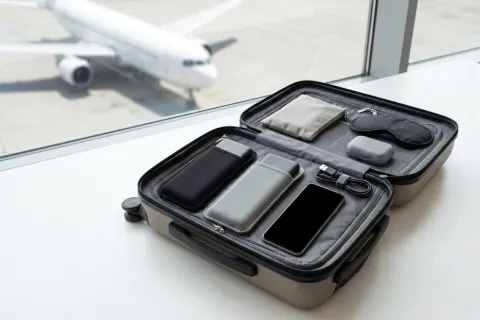
LOS ANGELES, Calif. - New regulations clarify which portable battery chargers you can bring on flights, with most travelers able to carry two 100-watt-hour power banks without airline approval.
Major US Airlines Ground Nearly 1500 Flights June 3
NEW YORK, N.Y. - Widespread disruptions across Texas, Illinois, California, Massachusetts, New Jersey, and New York grounded 142 flights and delayed 1,294 on June 3, 2026, stranding travelers on major carriers.

Alaska Airlines Hit With Fine for Boarding Drunk Flyers
SEATTLE — Alaska Airlines faces a proposed $165,000 FAA fine for allegedly allowing visibly intoxicated passengers to board 11 flights between February 2024 and February 2025.
Newark Airport Chaos Leaves United Flyers Trapped
NEWARK, N.J. - United Airlines passengers endured multi-hour tarmac delays at Newark Liberty International Airport on May 29, 2026, in an incident that underscores America's spiraling aviation reliability crisis.

About the Author

Mariana Torres
Mariana is a 33-year-old travel writer and backpacker who specializes in finding the pulse of a place far beyond the tourist maps.