Stay current with our travel industry news coverage.
The Ephemeral Architecture of Ice
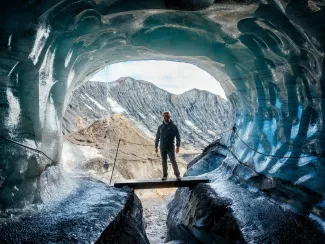
Glacier ice caves occupy a peculiar position in the hierarchy of natural wonders. Unlike mountain ranges or ancient forests that transform across geological time, ice caves exist in constant conversation with temperature, pressure, and the precarious balance of seasonal melt. They are architecture without architects, sculpture gardens that reshape themselves annually, sometimes within weeks. What travelers photograph in November may collapse by February. What guides discover in one season may never reappear. This volatility has become glacier tourism's defining characteristic and its primary hazard. The very conditions that create these spectacular formations, meltwater carving through compressed glacial ice, also ensure their impermanence. As global temperatures rise, that impermanence accelerates. Caves that once reformed reliably each winter now fail to materialize. Others become structurally unsound, their roofs thinning, their walls weakening under the weight of warmer air and increased water flow. The Crystal Ice Cave's vanishing represents not an anomaly but a pattern repeating itself across Iceland's ice caps and beyond. Guides who once led visitors to the same formations year after year now scout new locations each season, reading the ice like scouts reading terrain, seeking stable enough structures to safely accommodate tourism while knowing that stability itself has become a relative term.The Tourism Paradox
Glacier tourism exists in ethical and practical tension. The more spectacular these formations become through melt and transformation, the more visitors they attract. Yet every footfall contributes, however minimally, to the very degradation tourists come to witness. Heat from bodies, breath condensing in cold air, the simple mechanical pressure of weight on ice, all participate in the slow violence of warming. Iceland has grappled with this paradox more directly than most destinations. The island nation's glaciers have become pilgrimage sites for travelers seeking to witness these formations before they vanish entirely, a phenomenon some researchers term "last chance tourism." The impulse is understandable, even poignant. Yet it accelerates the cycle, drawing more visitors to increasingly fragile environments, placing greater strain on both the ice itself and the infrastructure required to access it safely. The safety concerns extend beyond environmental ethics into immediate physical risk. Ice caves that appear solid can harbor hidden weaknesses. Roof collapses, though rare, can be catastrophic. Temperature fluctuations create unpredictable conditions. What seemed secure in morning light may become dangerously unstable by afternoon. Reputable operators employ experienced guides who assess conditions daily, sometimes hourly, and turn groups away when risks escalate. But as demand increases and new operators enter the market, standards vary widely.Witnessing While We Can
I return to that photograph outside my son's room frequently, not with nostalgia but with something more complex. The image documents a moment, yes, but also captures a threshold. Somewhere between when Þorri pressed the shutter and when the print reached my wall, we crossed from preservation into elegy. The Crystal Ice Cave has joined the growing catalog of places that exist now primarily in memory and documentation. This raises uncomfortable questions for those of us who write about travel, who encourage exploration and connection to landscape. How do we balance the imperative to witness, to understand, to bear testimony to these transforming places, against the knowledge that our presence accelerates their transformation? How do we guide readers toward responsible engagement with environments under existential threat? There are no satisfying answers, only better and worse approaches. Choosing operators with rigorous safety protocols and environmental commitments. Traveling during shoulder seasons when pressure on sites eases slightly. Understanding that some experiences may no longer be available, and accepting that limitation rather than seeking them regardless of risk or impact. Recognizing that sometimes the most responsible choice is not to go at all. My son will likely never stand inside a formation like the Crystal Ice Cave his father photographed. The glaciers of his adulthood will bear little resemblance to those I first encountered two decades ago. What we leave him instead are stories, images, and the hope that bearing witness, even to loss, carries its own form of value.More travel news
CNN Reveals Top 2026 Destinations With Solar Eclipse
GLOBAL — CNN Travel unveils its curated list of 2026's most compelling destinations, anchored by a rare total solar eclipse and other time-sensitive travel opportunities.

Iceland Tops 2025 HelloSafe Travel Safety Index
Northern Europe once again dominates the 2025 HelloSafe Travel Safety Index, with Iceland topping a list of 180 countries analyzed across 35 risk factors.

Travelers splurge on business class to skip economy squeeze
Canadian travelers in Toronto and across North America are paying up for business and premium economy seats as airlines shrink legroom and add fees.

European Destinations Americans Can't Quit
United Kingdom, Germany and France draw record numbers of U.S. visitors in 2024 travel data, spotlighting the European destinations Americans return to again and again.

About the Author

Jeff Colhoun
Jeff Colhoun is an acclaimed travel writer, photographer, and filmmaker, whose work is respected both in the United States and internationally.