
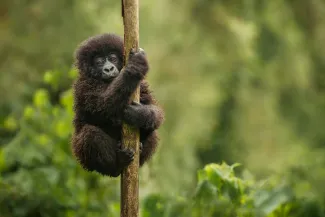
The silverback sits ten meters upslope, close enough that you can see the individual gray hairs across his shoulders catch the mist. He is chewing bamboo shoots with the deliberate rhythm of someone who has never once hurried through a meal, and when he glances in your direction the recognition is immediate and mutual: two primates, sharing 98.4% of our DNA, locked in a moment of assessment that feels less like observation and more like conversation. You have paid $1,500 for this hour. In sixty minutes a guide will tap your shoulder and you will walk back down the volcano. But right now, as a juvenile tumbles past your boots in pursuit of his brother, the permit fee has already become the least interesting part of the transaction.
While summer travelers this June scroll through Positano hotel listings and calculate the cost per night of Santorini caldera views, a different kind of journey beckons from Central Africa. Rwanda's Volcanoes National Park sits in the misty highlands where the Virunga Mountains knit together three countries, and what it offers cannot be framed in the language of luxury hospitality or Instagram backdrops. The permit to trek mountain gorillas costs $1,500 for foreign non-residents during peak season. On paper, that sounds extravagant for a single morning. In practice, it funds one of the most successful conservation interventions in modern history, protects a species that nearly vanished, and delivers an encounter so profound that most trekkers describe it in the language of pilgrimage rather than wildlife viewing.
This is not a safari drive where animals appear through a telephoto lens. This is walking into the cloud forest at 2,500 meters, climbing through bamboo thickets and stinging nettles, and sitting in the leaf litter while a family of mountain gorillas goes about the ordinary business of being alive. The dry season from June through September offers the clearest weather and firmest trails for that climb, which matters when the difference between June mud and September mud can mean an extra hour on your knees pulling yourself up volcanic slopes by exposed roots. But the deeper reason to make this journey now has nothing to do with weather windows and everything to do with what happens when you stop thinking of travel as a series of destinations and start recognizing certain places as thresholds.

The Gorillas That Came Back From the Brink
In the early 1980s, fewer than 400 mountain gorillas remained in the wild, scattered across two isolated populations in the Virunga Massif and Uganda's Bwindi Impenetrable Forest. Poaching, habitat loss, and the political instability that has defined Central Africa's recent history had pushed the species to the edge of extinction. Dian Fossey's research camp at Karisoke, high in the mountains between Rwanda and what is now the Democratic Republic of Congo, became the frontline of a conservation battle that cost Fossey her life in 1985. Her murder in her cabin remains officially unsolved, but her legacy became the foundation of a radically different approach: controlled tourism as a funding mechanism for protection.
Today, the most recent comprehensive census places the global mountain gorilla population at 1,063 individuals, split between the Virunga Massif shared by Rwanda, Uganda, and DR Congo, and the Bwindi-Sarambwe ecosystem in Uganda. Roughly half of the Virunga population lives within Rwanda's Volcanoes National Park, where about 12 gorilla families have been habituated for tourism and several additional groups remain reserved for research. The species is still classified as Endangered on the IUCN Red List, not recovered, not safe, but no longer sliding toward oblivion. That reversal did not happen through goodwill or international treaties. It happened because Rwanda made a calculated decision: make the gorillas worth more alive than dead, and make the communities living on the park boundary stakeholders in that value.
The $1,500 permit fee is the visible tip of a conservation finance model that few other countries have managed to replicate at scale. Permit revenue funds armed ranger patrols, veterinary teams that monitor gorilla health and intervene in snare injuries or disease outbreaks, anti-poaching operations, and a revenue-sharing system that directs a portion of tourism income to local infrastructure, schools, and health clinics. According to recent tourism data, between November 2025 and January 2026, Rwanda generated approximately $161.5 million in tourist-related revenue over just 90 days, with gorilla trekking tours accounting for 71.4% of that total. This is not incidental tourism. This is the economic engine that makes protection politically viable.
Dr. Tara Stoinski, president and chief scientific officer of the Dian Fossey Gorilla Fund, has noted in multiple interviews that the counterintuitive truth of mountain gorilla conservation is that controlled human contact became the species' salvation. Habituated gorilla families accept the presence of small groups of quiet humans at close range, which allows high-value ecotourism without the stress and disruption that would come from larger, less regulated visits. The protocol is strict: eight visitors maximum per family, one hour of viewing, seven-meter minimum distance (though gorillas often approach closer on their own terms), no visits if you are sick, masks required to reduce disease transmission risk. The rules exist because the gorillas' greatest vulnerability is also their greatest asset. They are close enough to us, genetically and behaviorally, that they can catch our respiratory infections. They are close enough to us, emotionally and cognitively, that an hour in their presence changes how people think about conservation for the rest of their lives.
When you pay $1,500 for a gorilla trekking permit, you are not paying for a tour. You are paying into a system where your presence is conservation funding first and tourism second. That distinction matters, because it reframes the value calculation entirely.

What the Dry Season Delivers
Volcanoes National Park sits in the Albertine Rift highlands, where the Virunga volcanoes rise above 4,000 meters and the forests that cloak their slopes stay wet for most of the year. The dry season is a relative term. Even in June and July, the driest months, you should expect cool temperatures, persistent mist, and the occasional afternoon shower. Daytime highs hover around 14 to 16 degrees Celsius at trekking elevations, and pre-dawn departures from park headquarters in Musanze can start at 6 to 8 degrees. This is montane cloud forest, not savanna. The weather does not cooperate; it tolerates.
But the difference between June and September, or between dry-season trekking and the wetter months of March through May or October through November, is meaningful if you are the one climbing. Drier trails mean firmer footing on the steep sections where you are pulling yourself up by bamboo stems or descending slopes slick with decomposing leaves. Less overnight rain means the porters who cut trail ahead of you spend less time hacking through mud-caked vegetation. Clearer mornings mean better odds of seeing the volcanic peaks when you reach higher elevations, though cloud cover can roll in by midday regardless of season. The window from June through early September offers the most consistently manageable trekking conditions, which matters when the physical challenge of reaching the gorillas is part of the earned quality of the encounter.
Weather reality: you will get wet. Even in July you should pack as if rain is guaranteed. Waterproof jacket and trousers, not water-resistant. Gaiters to keep mud and stinging nettles out of your boots. Gloves, because grabbing wet vegetation with bare hands on steep climbs is miserable. A daypack cover, because cameras and lenses do not respond well to equatorial downpours. Sturdy hiking boots with ankle support and deep tread, broken in before you arrive, because blisters at 2,800 meters when you still have two hours of descent ahead will teach you things about suffering that no Mediterranean beach ever will.
By September, the rains are beginning to return. Trails become slicker, river crossings rise, and the bamboo zones turn into ankle-deep mud troughs. Treks continue year-round; habituated gorilla families do not take holidays and the park does not close for weather. But if your knees are suspect, your balance uncertain, or your tolerance for physical discomfort limited, June through August offers the most forgiving conditions. If you are reasonably fit, accustomed to long walks, and comfortable with the idea that "moderate difficulty" in a volcanic cloud forest means something different than "moderate difficulty" on a marked trail in the Rockies, any month will work. The gorillas do not care when you visit. The mud does.

The Trek Itself: Effort and Reward
You leave your lodge in Musanze before dawn, because the briefing at Volcanoes National Park headquarters begins at 7:00 am and lateness is not tolerated. The briefing is part logistics, part theater: park rangers in uniform, coffee and tea available, a short talk about gorilla behavior and trekking protocol, then the group assignments. There are roughly 12 habituated families available for tourism on any given day, each assigned a maximum of eight trekkers. You do not choose your family. The park assigns groups based on a rough fitness assessment and where the advance trackers have located gorillas that morning. If you indicated at booking that you have mobility limitations, you might be assigned to Sabyinyo or Amahoro, families that typically stay at lower elevations. If you are young and fit, you might draw Susa, the large family that roams high into the bamboo and hagenia zones and can require six hours of climbing to reach.
You are strongly encouraged to hire a porter. This is not about carrying your lunch; porters are former poachers, farmers who once saw the park as a threat to their land, now employed in the tourism economy that replaced subsistence farming on the volcano's edge. A porter will carry your daypack, offer a hand or a shoulder on steep sections, cut trail when vegetation blocks the path, and steady you on descents where the mud has turned the slope into a slide. The going rate is approximately $20, plus a tip if you are pleased with the help, which you will be. Hiring a porter is both practical assistance and a direct contribution to the community revenue-sharing model that makes conservation politically sustainable here.
The walk begins at the park boundary, where farmland ends and forest begins with the abruptness of a drawn line. You cross into bamboo thickets first, dense stands where the stalks grow thick as your wrist and the canopy filters the light into a green underwater glow. The trail is not marked. Your guide and tracker walk ahead, following radio updates from the advance trackers who have been shadowing your assigned gorilla family since before sunrise, noting where the group nested overnight and which direction they are feeding. You climb. The gradient steepens. The bamboo gives way to hagenia woodland, ancient trees draped in moss and lichen, the understory choked with vines and stinging nettles that brush your legs despite gaiters. You are breathing hard now, not from altitude sickness but from sustained effort at 2,500 to 3,000 meters, where the air holds less oxygen and every uphill step costs more than it would at sea level.
Then the guide stops, holds up a hand, and points. Twenty meters ahead, half-hidden in a thicket of wild celery, a female mountain gorilla is feeding, her infant clinging to her back. The guide gestures: masks on, cameras ready, voices low, no sudden movements. You have found them. The hour begins now.
What happens in that hour resists summary. The protocol says you must stay seven meters away, but the gorillas do not recognize human rules and often approach much closer. A juvenile might knuckle-walk past you to reach a vine on the other side of the trail, close enough to touch, though you do not. A silverback might shift position and settle five meters uphill, his back to you in a posture of studied indifference that still communicates absolute authority over this space. Mothers nurse infants, adolescents wrestle and tumble through the undergrowth, elders groom each other with the patience of creatures who measure time in seasons rather than minutes. You watch a blackback; a young male not yet fully mature, crack bamboo stems with his hands and strip the soft inner pith with his teeth, and the gesture is so familiar, so human in its deliberate precision, that for a moment you forget you are watching a different species.
The physical demand of the trek varies wildly depending on where the gorillas have moved overnight. Some groups stay close to the park boundary and can be reached in an hour of steady walking. Others range high into the saddle zones between volcanoes, requiring three or four hours of steep climbing each way. Fitness matters, but it is not a technical challenge. You do not need mountaineering skills or trail-running conditioning. You need the ability to walk for several hours on uneven, steep, sometimes muddy ground, and the humility to accept that the mountain sets the pace. Trekkers in their sixties complete this regularly. Trekkers in their twenties sometimes struggle. The difference is usually preparation, mindset, and willingness to let the porters do the work they are there to do.
When the hour ends, the guide taps your shoulder. You stand, brush the leaf litter from your trousers, and begin the descent. The return is always faster, gravity assisting, but your legs are shaking now and the mud that was merely annoying on the way up has become treacherous on the way down. You do not talk much. Most trekkers walk in silence, processing what just happened, trying to hold onto details that are already starting to blur: the smell of wet vegetation and musky gorilla fur, the sound of a silverback's chest-beat echoing through the trees, the weight of a mother's gaze as she assessed whether you were a threat to her infant and decided you were not.

The Gorilla Families: Characters in the Mist
Volcanoes National Park maintains about a dozen habituated family groups available for tourism, each with distinct personalities, ranging patterns, and social dynamics. You cannot choose which family you will trek, and that randomness is part of the design. This is an encounter, not a performance. The gorillas are not there for you. You are a tolerated presence in their territory, and the family you meet is the family the trackers have located that morning in terrain your fitness level can reasonably handle.
Susa is the largest and most famous family, historically numbering over 40 individuals though groups split and reconfigure as silverbacks mature and challenge for dominance. Susa roams the highest elevations, deep into the bamboo zones and up toward the saddle between Mount Karisimbi and Mount Bisoke. Trekking Susa often means a long, steep climb, but the reward is encountering a complex multi-generational group that includes rare twins, an unusual occurrence in mountain gorillas, and a social structure so layered that watching the group's interactions can feel like observing a small village. Susa is not for travelers with limited mobility or low stamina. This is a full-day commitment.
Kwitonda is named after the dominant silverback who led the family across the border from DR Congo into Rwanda years ago. Kwitonda the silverback is a massive, powerful male, and the family he leads tends to stay in the bamboo forest zones at mid-elevation. The treks to reach Kwitonda are moderately difficult, and the group is known for calm, approachable behavior. Watching Kwitonda feed, methodically stripping bamboo and chewing with the unhurried confidence of an apex presence, offers a clear reminder that silverbacks can weigh over 200 kilograms and possess strength that would make short work of any human foolish enough to provoke them. They do not need to demonstrate that strength. The potential is visible in the breadth of their shoulders and the stillness with which they hold space.
Hirwa is a younger, smaller family, formed relatively recently when a silverback successfully attracted females away from other groups. Hirwa tends to stay at lower elevations and closer to the park boundary, making the trek shorter and less strenuous. For trekkers concerned about fitness or those with time constraints, Hirwa offers a more accessible encounter without sacrificing the intimacy and impact of the experience. The group includes playful juveniles and young infants, and watching their interactions offers insight into how mountain gorilla families form and stabilize around a strong male capable of defending territory and resources.
Other families, such as Amahoro ("peace" in Kinyarwanda), Sabyinyo, Agashya, Umubano, and Bwenge, each carry their own histories of splits, migrations, and dominance shifts. Amahoro is known for its relaxed temperament and lower-elevation range. Agashya, also called Group 13, is led by a silverback with a reputation for assertiveness and strategic territory control. Umubano split from Amahoro years ago and remains a stable mid-sized family. The details matter less than the principle: these are not interchangeable wildlife viewing opportunities. These are distinct social groups, each shaped by the personality of the dominant silverback, the history of the females who chose to stay or leave, and the terrain they have claimed as their range.
Mothers and infants offer the most emotionally direct parallels to human behavior. Watching a mother adjust her infant's position while feeding, or gently pull a youngster back from a steep drop, or ignore a tantrum with the weary patience universal to parenthood, collapses the genetic distance between species. You see your own gestures reflected. The silverback commands respect and attention, but it is the mothers and young who tend to provoke the deepest recognition, the moment when the boundary between observation and empathy dissolves and you are simply watching a family navigate the ordinary challenges of survival, growth, and care.
The Economics of Splurge Travel
The $1,500 gorilla trekking permit for foreign non-residents in peak season is not the only cost, and understanding the full financial commitment is necessary for honest trip planning. The permit is issued by the Rwanda Development Board and covers one trek, one family, one hour of viewing. If you want to trek twice, you need two permits. If you are traveling with a partner, that is $3,000 in permits alone before you have paid for a single night of accommodation or a single meal.
Flights into Kigali Entebbe International Airport vary by season and routing. According to current Google Flights data, a roundtrip ticket from New York to Johannesburg, often used as a regional hub for connections into East Africa, runs approximately $1,566 for late June travel. Rwanda is not Johannesburg, but the point holds: getting to Central Africa from North America or Europe is not cheap, and you should budget $1,200 to $2,000 for long-haul flights depending on your departure city and booking timing. Ground transfers from Kigali to Musanze, the gateway town for Volcanoes National Park, take about 2.5 hours and can be arranged privately or through tour operators for $100 to $200 each way.
Accommodation in Musanze and the area immediately surrounding Volcanoes National Park ranges from budget guesthouses at $50 per night to ultra-luxury lodges at $1,500 per night or more. Mid-range options such as the Mountain Gorilla View Lodge or Tiloreza Volcanoes Ecolodge fall in the $200 to $400 per night range and offer comfort, good food, and proximity to the park without the premium pricing of the high-end properties. If you are doing two treks over three nights, expect to spend $600 to $1,200 on lodging depending on your tolerance for luxury versus budget efficiency.
Add in meals not included in your accommodation, park entry fees, porter hire at approximately $20 per trek, guide tips, and incidental costs, and a three to four day gorilla-focused trip to Rwanda typically runs $3,500 to $7,000 per person for a mid-range experience, significantly more if you are staying at properties such as Bisate Lodge or Singita Kwitonda, where nightly rates exceed $1,000. For travelers accustomed to all-inclusive beach resorts in the Caribbean or Mediterranean packages that bundle flights and hotels for under $2,000, this is a different category of expense.
The value calculation is subjective until it is not. One hour with mountain gorillas for $1,500 sounds absurd on a spreadsheet. After you have done it, the math inverts. It becomes the bargain of your life, the hour you would pay $1,500 to repeat, the experience against which you measure every other travel splurge. This is less than a business-class transatlantic ticket. It is comparable to a mid-tier week-long safari in Tanzania or Botswana. It is more than most travelers spend on any single day of any trip they will take. But it is not a transaction; it is a threshold. You are not paying for a service. You are paying for access to a moment that reorders your sense of what travel can mean.
Who this suits: travelers who have moved beyond collecting destinations and are seeking experiences that carry weight, that linger, that resist the Instagram flattening of travel into aesthetics. If your reference point for value is thread count and turndown service, gorilla trekking may frustrate you. If your reference point is transformation, the permit fee will feel like the least important line item in the budget.
Planning the Pilgrimage: Permits and Logistics
Permits for Rwanda's gorilla trekking are issued by the Rwanda Development Board on a first-come, first-served basis, with no lottery system and no waiting list. For peak dry season dates in June, July, and August, you should book three to six months in advance to secure your preferred dates. For group travel or fixed itineraries built around specific dates, booking up to 12 months ahead is standard practice. The RDB operates an online booking portal where you can check availability, select dates, and pay via credit card; confirmation is instant if permits are available.
Alternatively, you can book through a tour operator who will bundle permits with accommodation, transfers, guides, and logistics. This adds a markup, sometimes significant, but simplifies coordination and guarantees that all elements of your trip align. Operators such as Volcanoes Safaris, Wilderness Safaris, or local Rwandan companies can handle the entire package, which is worth considering if you are adding golden monkey trekking, Nyungwe Forest chimpanzee tracking, or Lake Kivu extensions to your itinerary.
Fitness requirements are officially listed as moderate, which in practice means you should be capable of hiking one to six hours on steep, uneven, muddy trails at elevations between 2,500 and 3,500 meters. You do not need to be an athlete, but you should be honest about your conditioning and limitations. If you have not walked more than an hour at a time in the past year, do not assume that enthusiasm will substitute for cardiovascular fitness when you are climbing a 20-degree slope in thin air. Pre-trip conditioning; long walks, hill climbs, stair work, treadmill incline sessions, will make the trek significantly more comfortable and allow you to focus on the gorillas rather than your burning lungs.
The age minimum is 15 years, strictly enforced, based on disease transmission risk and the unpredictability of gorilla behavior around younger children. If you are traveling with family, this limits options; Rwanda is not a destination for young children in the context of gorilla trekking, though older teenagers often find the experience profoundly formative.
Health protocols remain stringent. You cannot trek if you have any symptoms of illness, respiratory or otherwise. COVID-19 protocols introduced mask-wearing near gorillas to reduce zoonotic disease transmission, and those requirements are likely to remain in place indefinitely given the vulnerability of great apes to human pathogens. You will be asked to confirm your health status at the morning briefing. If you lie and trek while sick, you risk not only the health of an endangered species but also a lifetime ban from the park.
Kigali itself deserves a day or two before or after your trek. The city is clean, safe, walkable in daylight, and home to the Kigali Genocide Memorial at Gisozi, the most important historical and educational site in the country. The memorial is a final resting place for approximately 250,000 victims of the 1994 Genocide against the Tutsi and includes indoor exhibitions on the history of ethnic division, the genocide's planning and execution, and Rwanda's post-genocide reconciliation and justice processes. The memorial is open from 9:00 am to 5:00 pm most days, with last entry at 4:00 pm, and admission is free though donations are encouraged to support its educational mission. Visiting the memorial is not required, but skipping it means missing the context that makes Rwanda's current stability and conservation success comprehensible. This is a country that rebuilt itself from catastrophic violence into one of the safest, cleanest, and most effectively governed states in Africa. Understanding that trajectory is part of understanding why the gorilla model works here and struggles elsewhere.
Multi-country options exist for travelers with time and budget. Uganda's Bwindi Impenetrable National Park offers mountain gorilla trekking at $800 per permit, significantly cheaper than Rwanda, though the terrain is often steeper and muddier and logistics more complex. DR Congo's Virunga National Park offers the lowest permit prices but carries security risks that fluctuate with regional conflict; check current advisories carefully before considering this option. For most first-time gorilla trekkers, Rwanda offers the best balance of accessibility, infrastructure, safety, and permit availability.
Beyond the Gorillas: Why Rwanda Rewards Lingering
Most travelers build a Rwanda itinerary around two gorilla treks over three or four days, but the country offers enough additional depth to justify a week to ten days on the ground. Golden monkey trekking in Volcanoes National Park costs approximately $100 per permit and offers a very different primate encounter: playful, fast-moving monkeys that live in bamboo forests and seem perpetually in motion, leaping between stalks and feeding in constant chatter. The trek is shorter and less strenuous than gorilla trekking, and the behavior of golden monkeys; energetic, social, curious, provides a useful counterpoint to the calm, deliberate presence of mountain gorillas.
A hike to Dian Fossey's grave at the old Karisoke research station is a pilgrimage within a pilgrimage for anyone who has read her work or understands her role in mountain gorilla conservation. The trail climbs to over 3,000 meters and takes three to four hours round trip. Fossey is buried alongside several of the gorillas she studied and fought to protect, including Digit, the young male whose killing by poachers galvanized international attention. The site is remote, often shrouded in mist, and carries the weight of history in a way that few tourist sites manage.
Nyungwe Forest National Park in southern Rwanda is one of Africa's oldest montane rainforests, home to 13 primate species including chimpanzees, colobus monkeys, and L'Hoest's monkeys. Chimpanzee tracking permits cost approximately $90 and offer another high-energy primate encounter, though chimps are less predictable and harder to track than gorillas. Nyungwe also features a canopy walkway suspended 50 meters above the forest floor, offering a perspective on the rainforest canopy that few other parks provide. The drive from Volcanoes National Park to Nyungwe takes about five hours through Rwanda's famously hilly interior, terraced with tea plantations and dotted with rural villages.
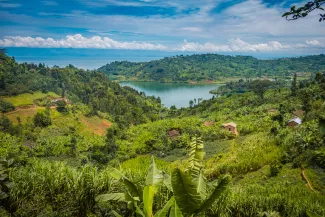
Lake Kivu, Rwanda's largest lake and one of Africa's Great Lakes, offers an unexpected counterpoint to the intensity of mountain trekking: beaches, boat trips, kayaking, and boutique lakeside lodges in towns such as Gisenyi and Kibuye. The lake is volcanic in origin, deep and clear, and safe for swimming unlike many African lakes plagued by bilharzia or hippos. A few days on Lake Kivu at the end of a gorilla and chimp itinerary provides physical recovery time and mental decompression before the long flight home.
Kigali rewards exploration beyond the genocide memorial. The city's restaurant scene is modest but growing, with spots such as Heaven Restaurant and Repub Lounge offering decent food and rooftop views. The Inema Arts Center showcases contemporary Rwandan visual art. The city is famously clean; plastic bags are banned, and the last Saturday of each month is Umuganda, a national community service day when residents participate in local cleanup and infrastructure projects. Walking through Kigali's neighborhoods, you see a level of civic organization and public order rare in the region.
Cultural encounters near Volcanoes National Park, such as visits to Iby'Iwacu Cultural Village, offer opportunities to meet former poachers who now work as guides and artisans, demonstrating traditional Rwandan dance, crafts, and village life. These experiences vary in quality and can feel performative, but they provide direct economic alternatives to poaching and help explain how tourism revenue reaches communities on the park boundary.
The Photograph You Won't Take
You are allowed cameras. You can shoot stills and video during the hour with the gorillas, and most trekkers fill memory cards with images of silverbacks, infants, feeding sequences, and play behavior. But something happens during that hour that resists documentation. You find yourself lowering the camera more often than raising it. You watch instead of shooting. You try to hold the moment in memory rather than framing it through glass.
The most powerful images, when you do take them, are often close-ups of hands, eyes, or infants clinging to mothers. The wider shots, the context frames, the "proof I was here" compositions, tend to feel flat when you review them later. What you remember is sensory detail the camera does not capture: the smell of wet vegetation and musky gorilla fur, the sound of bamboo cracking as a silverback feeds, the soft rumbles and grunts that pass between family members, the profound silence that settles when the group rests and you sit in the leaf litter ten meters away trying not to breathe too loudly.
The empathy jolt, when it comes, is usually visual but not photographic. You watch a mother groom her infant, and the tenderness of the gesture, the patience, the attentiveness, mirrors something you have seen in your own family or your own hands. You watch a silverback yawn, and the weariness in his face, the weight of his responsibility for the family's safety and cohesion, registers not as animal behavior but as something closer to recognition. These moments do not translate well to Instagram. They are too interior, too quiet, too resistant to the quick scroll and the double-tap.
Why this experience resists social media has less to do with image quality and more to do with the encounter's emotional register. The hour with gorillas operates at a frequency that does not compress into captions. It lingers. It resurfaces in unexpected moments: in meetings, in traffic, in the middle of ordinary days when the gap between what matters and what fills your time becomes suddenly, uncomfortably visible. The gorillas become a reference point, a measuring stick, a reminder that scale exists beyond the human and that some experiences justify their cost precisely because they cannot be reduced to content.
The Counterargument to the Mediterranean
The Amalfi Coast is beautiful. Santorini sunsets are stunning. Greek island ferries are pleasant. None of this is in dispute. But if you have done the beach clubs and the caldera-view hotels and the Aperol spritzes at sunset, and you are starting to notice that the photographs from this year's summer trip look remarkably like last year's and that the memories blur together into a pleasant but ultimately interchangeable series of tans and rosés and Instagram posts that earned good engagement but did not change anything, then the $1,500 gorilla trekking permit is a different kind of proposition.
Not all expensive travel is worthwhile. Plenty of luxury experiences deliver exactly what they promise and leave you no different than you arrived, just poorer and temporarily more relaxed. But certain experiences justify their cost by changing how you see the world, and the markers of those experiences are usually discomfort, effort, and a nagging sense that what you are doing matters in a way that transcends personal enjoyment. Gorilla trekking in Rwanda checks all three.
The June through September window offers the clearest trails, the driest weather, and the most comfortable trekking conditions. If you go in July, you will hike through less mud and have firmer footing on the steep sections. If you go in March, you will slip more, sweat more, and probably swear more. Either way, you will reach the gorillas. Either way, the hour will pass too quickly. Either way, you will walk back down the mountain with your legs shaking and your heart full of something that resists articulation but refuses to fade.
Rwanda's broader story, the arc from genocide to reconciliation, from collapse to one of Africa's most stable and forward-looking nations, is part of what makes the gorilla experience meaningful. This is not wildlife tourism in a vacuum. This is conservation embedded in a larger project of national rebuilding, of proving that protection and prosperity can align, of demonstrating that communities benefit more from living gorillas than dead ones. The model works here because the government committed to it, because communities bought in, because enforcement is serious, and because visitors pay enough to make the entire system financially sustainable. The $1,500 permits fund rangers, veterinary care, anti-poaching patrols, and revenue-sharing schemes that build schools and clinics. Your presence, expensive and brief and tightly controlled, is what keeps the gorillas alive.
The final image: you hike back down the volcano, legs shaking, clothes streaked with mud, camera full of photos that will never quite
About the Author

Wilson Montgomery
Wilson Montgomery is a British-born travel writer who has carved a niche for himself with his compelling narratives about African travel and safari experiences.