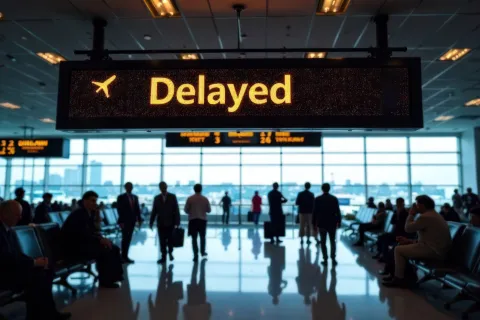
Jakarta's Main Airport Ceiling Gives Way During Monsoon Storm
JAKARTA, Indonesia — The ceiling came down like a five-minute waterfall at Jakarta's Soekarno-Hatta International Airport on Monday afternoon, sending passengers scrambling and disrupting 40 flights. But here's the good news: everyone got out before the collapse, and no one was hurt. The failure happened near Gate 7 in Terminal 2D around 1:45 p.m. local time, according to View from the Wing. Days of heavy rainfall had apparently overwhelmed the drainage systems, and when the ceiling finally gave way, water gushed through for about five minutes before staff could cordon off the area and start cleanup. Video footage circulating on Indonesian media showed what looked less like an airport terminal and more like an indoor waterfall — one observer compared it to "the waterfall at Jewel Changi Airport," though I'm guessing Singapore's designers had something more intentional in mind. Passengers who were nearby reportedly ran clear before the collapse; airport staff then moved quickly to restrict access and shift operations to other gates.Flight Disruptions Pile Up During Weather Crisis
The ceiling collapse was just part of a rough day for Soekarno-Hatta. Weather conditions were bad enough that 12 flights diverted to other airports, 14 entered holding patterns, 13 executed go-arounds, and one returned to the apron, according to View from the Wing. Indonesia's meteorological agency, BMKG, had issued red weather alerts for Greater Jakarta as rainfall reached 150mm in just six hours. All told, 40 flights saw some kind of disruption. Research indicates that breakdown included 28 delays averaging two to four hours, 10 cancellations (mostly domestic routes to Bali, Surabaya, and Medan), and two diversions. The affected section of Terminal 2D was closed entirely, with operations shifted to Terminals 2F and 3 while repairs got underway. PT Angkasa Pura II, the airport's operator, estimated material damage at IDR 5-10 billion (roughly USD 300,000-600,000), according to a preliminary statement from CEO Muhammad Awaluddin. The damage affected ceiling panels, lighting systems, and HVAC infrastructure. The terminal section was expected to reopen within 48 hours.A Pattern of Weather-Related Failures
If this sounds familiar, it's because Soekarno-Hatta has been here before. The airport experienced significant leaks during heavy rains in 2020, and another ceiling collapse in 2023. Both incidents followed the same script: monsoon rains, overwhelmed drainage, structural failure. The airport was built in the 1990s and handles over 60 million passengers annually in normal times, making it Indonesia's busiest hub and a critical gateway for both domestic and international travel. But its aging infrastructure has struggled to keep pace with Jakarta's tropical monsoon climate, which dumps heavy rainfall from November through April every year. Critics have pointed to maintenance delays and issues flagged in audits by Indonesia's Corruption Eradication Commission (KPK). There's a broader masterplan with IDR 100 trillion in investment aimed at boosting capacity to 100 million passengers, but contractor disputes and funding delays have slowed progress. The government pledged an emergency fund of IDR 500 billion for repairs following Monday's collapse, according to a Ministry of Transportation press release.Should You Rethink Your Jakarta Connection?
If you've got flights through Soekarno-Hatta during Indonesia's rainy season — roughly November through April — it's worth building in extra buffer time. This isn't the first ceiling to come down during a monsoon, and until those infrastructure upgrades are complete, it probably won't be the last. The good news is the airport appears to have solid evacuation procedures; 200 passengers and 50 staff cleared the area safely on Monday, which suggests lessons learned from earlier incidents. But flight disruptions are becoming predictable during heavy weather. Those 40 affected flights represent not just missed connections but ripple effects through schedules for days afterward, especially on popular domestic routes to Bali and Surabaya. For travelers booking through Jakarta, consider: Can you route through Singapore or Bangkok instead? If not, are you flying during peak monsoon months when weather disruptions are most likely? Garuda Indonesia and other carriers operating through CGK have been hit hard by these incidents; revenue takes a beating when planes sit on the ground or passengers rebook through competitors. Indonesia's government sees this as an isolated incident in an otherwise growing aviation market, and they're not entirely wrong. But aging infrastructure plus intensifying monsoon rains is a troubling combination. Until those promised upgrades move from pledges to concrete (literally), Jakarta's main airport remains vulnerable every time the skies open up.More travel news
Over 200 Asian Flights Canceled Across 3 Countries
JAKARTA, Indonesia - Garuda, AirAsia, Malaysia Airlines, Lion Air, and Batik Air face over 200 flight cancellations across Indonesia, Malaysia, and Hong Kong, stranding travelers on domestic and international routes.
Overwhelmed Hotspots Now Tell Tourists to Stay Away
DENPASAR, Indonesia — Tourism authorities are encouraging travelers to reconsider visits to saturated destinations like Bali and Venice, where the convergence of masses following identical itineraries has created severe environmental and cultural strain.

Giant Pythons Swim Through Bali's Flooded Streets
DENPASAR, Indonesia — Viral videos capture six-foot pythons navigating flooded Bali streets as historic rainfall transforms tourist hubs into waterways, displacing hundreds.

Monkey Attacks Lead Bizarre Travel Insurance Claims
UBUD, Indonesia — A surge in monkey bite claims highlights how quickly wildlife encounters escalate from photo ops to medical crises requiring rabies treatment and six-figure evacuations.

About the Author

Bob Vidra
Bob Vidra, based in scenic Tahoe, is an esteemed tech editor known for his deep understanding of the dynamic intersection of technology, travel, and the outdoors.