Stay current with our airline news coverage.
Crew Response and Cabin Conditions
By the time the aircraft landed in San Francisco, the carpet around row 7 had reportedly turned a "rich brown" from the combination of repeated incidents and coffee grounds layered on top, according to Live and Let's Fly. The crew's use of coffee grounds, a common odor-masking technique for biological messes, suggests limited options for managing a multi-event contamination scenario at 35,000 feet. One passenger seated in row 7 was relocated to an exit row seat, the only open seat on the aircraft, according to the publication. That detail alone tells you something about the severity: exit row seats don't get given away lightly on a full flight. The fact that crew felt compelled to move someone indicates conditions around the affected row had become untenable.Ground Crew Alert
As the flight prepared to deplane in San Francisco, crew members reportedly alerted colleagues waiting outside the door that there was poop in row 7 and that management should be informed that conditions were "really unsanitary," according to Live and Let's Fly. That kind of communication between flight crew and ground staff is standard protocol for biohazard situations requiring deep cleaning beyond what cabin crew can accomplish in flight. It also flags the aircraft for potentially extended ground time while contract cleaners address contaminated carpet and surrounding surfaces.The Service Animal Question
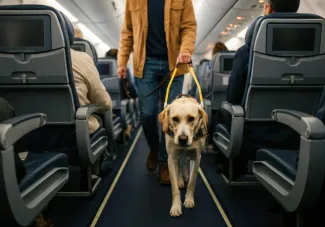
The characterization of the animal as a "service dog," at least initially, raises familiar questions about enforcement of airline pet policies. United Airlines policy permits trained service animals to travel in the cabin without carriers, but those animals remain subject to removal if they pose a direct threat to health or safety or cause significant disruption. The gap between policy and practice becomes glaring when crew face a live situation involving a passenger who claims disability accommodation. Removing an animal mid-flight is not an option. Crew are left managing the mess with whatever supplies are available in the galley, which explains the coffee grounds. This mirrors other documented incidents. United Flight 422 from Houston to Seattle diverted to Dallas after a dog defecated in the aisle, requiring over two hours of ground cleaning. On another United flight from Denver to Portland, a Chihuahua soiled a passenger's lap, blouse, pants, and armrest. In both cases, crew provided sanitizing wipes and vouchers, but the smell persisted.What Changed and What Didn't
Airlines tightened service animal rules following years of abuse under previous regulations that allowed passengers to bring exotic animals and untrained pets aboard simply by claiming emotional support needs. Current DOT rules limit service animals to dogs trained to perform tasks for passengers with disabilities. But enforcement still relies heavily on passenger attestation. Airlines can require advance documentation, but once a passenger boards with an animal and claims it's a trained service dog, crew have few tools to verify that claim or manage an animal that becomes disruptive or unsanitary. What this incident underscores is the operational reality for crew and surrounding passengers. A service animal that repeatedly soils the cabin creates a biohazard situation that cannot be fully addressed in flight. Crew are left improvising with coffee grounds while passengers breathe contaminated air for hours. The practical calculus for travelers is straightforward: if you're seated near a dog on a full flight, you may have no recourse if the animal creates a sanitation issue. Exit row relocation, as happened here, depends entirely on seat availability. On a sold-out aircraft, you're stuck. For crew, the incident highlights a training and resource gap. Biohazard kits exist, but they're designed for human medical emergencies, not repeated animal waste events over multiple hours. The use of coffee grounds suggests crew were working outside standard procedure because standard procedure doesn't adequately address this scenario. Airlines that want to reduce these incidents have clear options: require advance notice for all service animals, mandate veterinary health certifications, and enforce consequences for animals that violate cabin sanitation. Until that happens, crew will keep reaching for the coffee grounds.More travel news
Flying With Power Banks: New Rules for LA Travelers
LOS ANGELES, Calif. - New regulations clarify which portable battery chargers you can bring on flights, with most travelers able to carry two 100-watt-hour power banks without airline approval.
Major US Airlines Ground Nearly 1500 Flights June 3
NEW YORK, N.Y. - Widespread disruptions across Texas, Illinois, California, Massachusetts, New Jersey, and New York grounded 142 flights and delayed 1,294 on June 3, 2026, stranding travelers on major carriers.

Newark Airport Chaos Leaves United Flyers Trapped
NEWARK, N.J. - United Airlines passengers endured multi-hour tarmac delays at Newark Liberty International Airport on May 29, 2026, in an incident that underscores America's spiraling aviation reliability crisis.

United Pilot Threatens FBI Over Passenger Hotspot Name
Seattle, Wash. - A pilot's ultimatum over a hotspot name sparks questions about authority, speech, and de-escalation at 35,000 feet.

About the Author

Jeff Colhoun
Jeff Colhoun is an acclaimed travel writer, photographer, and filmmaker, whose work is respected both in the United States and internationally.